
Play FreeCell Online for Free
FreeCell Solitaire is a strategy-based card game where all 52 cards are dealt face-up, and nearly every deal is winnable with the right moves. Unlike classic Solitaire, FreeCell gives you complete information from the start. You can see every card and plan each move using skill rather than luck.
At Solitaire.com, you can play FreeCell Solitaire free in your browser with no downloads or registration needed. You also get helpful features like Unlimited Undo, a Hint button, and daily Solitaire challenges. FreeCell is one of the most popular types of solitaire games, and a great choice for first-time players and lifelong card game fans alike.
What Is FreeCell Solitaire?
FreeCell Solitaire is a single-player card game where all 52 cards are dealt face-up into eight columns, and you use four temporary holding spots called free cells to organize your moves.
The goal is to move all cards to four Foundation piles, sorted by suit from Ace to King. For example, one Foundation pile would hold A♠, 2♠, 3♠, and so on up to K♠.
What makes FreeCell different from most solitaire card games is visibility. Every card is face-up from the start. There are no face-down cards. You win or lose based on the choices you make.
FreeCell gained popularity through Microsoft Windows in the 1990s. Roughly 99.999% of FreeCell deals are winnable with the right strategy. That said, even experienced players don't win every game on the first try.
FreeCell Game Setup: Understanding the Layout
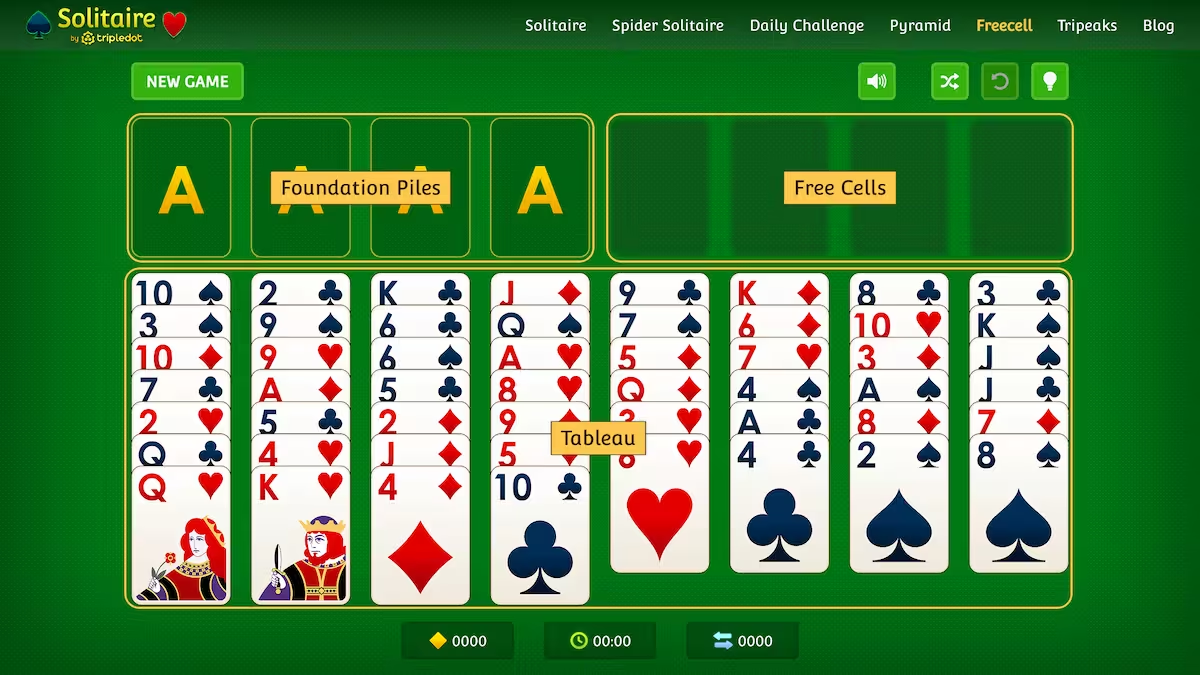
A FreeCell Solitaire game begins with all 52 cards dealt face-up across eight columns, with four free cells and four Foundation piles above them.
Here's what each area does:
Tableau
Eight columns of face-up cards. The first four columns each hold 7 cards. The last four hold 6 cards each. You can see every card from the start.
Free Cells
These are four empty spots in the top-left corner of the game. Each one holds a single card at a time. Think of them as temporary parking spaces. You move cards here to clear the way for other moves.
Foundation
These are four empty piles in the top-right corner. You build each Foundation pile from Ace to King within the same suit. Hearts, Diamonds, Clubs, and Spades each get their own pile.
No Stock Pile
Unlike Klondike Solitaire, FreeCell has no stock pile. You won't draw cards from a deck. Every card you need is already visible on the board.
FreeCell Rules: Moves and Sequences
FreeCell follows a few clear rules that control how you move cards between the tableau, free cells, and Foundation piles.
Moving Cards in the Tableau
You can place a card on top of another if it is one rank lower and the opposite color. For example, place the 7♥ on the 8♠. You cannot place the 6♦ on the 7♥ because both are red.
This alternating color pattern helps you build sequences. A correct sequence might look like: 10♣, 9♦, 8♠, 7♥.
Using the Free Cells
You can move any single exposed card from a column into an open free cell. Each free cell holds only one card. Cards in free cells can move back to the tableau or to a Foundation pile.
Try not to fill all four free cells at once. Keeping them open gives you flexibility for future moves.
Building the Foundation
Cards move to Foundation piles from Ace to King within the same suit. Start with the A♦, then add the 2♦, 3♦, and so on up to K♦. Each suit builds its own pile.
Moving Multiple Cards at Once
FreeCell lets you move a group of sequenced cards together if you have enough open spaces. The formula is simple: movable cards = empty free cells + 1.
- 4 empty free cells = move up to 5 cards
- 2 empty free cells = move up to 3 cards
- 0 empty free cells = move only 1 card
An empty tableau column doubles this number. For example, with 1 open free cell and 1 empty column, you can move 4 cards instead of 2.
Empty Columns
When a column is cleared completely, you can place any card there. This is different from Klondike, where only Kings can fill an empty column. This extra flexibility is one reason FreeCell rewards careful planning.
How to Play FreeCell Step-by-Step
Playing FreeCell Solitaire follows a clear pattern once you understand the layout and rules.
Step 1: Scan the Tableau
Before making any moves, look at all eight columns. Find where your Aces and low cards (2s and 3s) are located. If an Ace is already exposed at the bottom of a column, move it to a Foundation pile right away.
Step 2: Free the Low Cards
Next, work on uncovering buried Aces and 2s. Move the cards that block them. Use a free cell to hold a card that's in the way temporarily. For example, if the A♣ is buried under a 5♥, move the 5♥ to a free cell to reach the Ace.
Step 3: Build Sequences in the Tableau
Then, start stacking cards in descending order with alternating colors. Place the 10♦ on the J♣, then the 9♠ on the 10♦. Longer sequences give you more options as the game progresses.
Step 4: Create Empty Columns
Try to clear at least one full column early in the game. An empty column works like a super-powered free cell. It can hold any card, and it doubles the number of cards you can move at once.
Step 5: Build the Foundations
Move cards to Foundation piles as they become available. Continue building each suit from Ace to King until all four piles are complete.
If you're unsure about your next move, try the Hint button. You can also use Unlimited Undo to go back and try a different path. FreeCell Solitaire is free to play online at Solitaire.com with no download needed.
FreeCell Strategy: How to Win More Games
Winning at FreeCell Solitaire depends on planning and keeping your options open, not on rushing cards to the Foundation.
Keep Free Cells Empty
Every filled free cell reduces the number of cards you can move at once. With all four filled, you can move only one card at a time. Use free cells only when no better move is available.
Clear Columns Early
An empty column is more valuable than a free cell. It can hold an entire sequence of cards and doubles the number of cards you can move. Focus on clearing shorter columns first.
Don't Rush Cards to the Foundation
This might seem odd at first. Here's why it works: a card in the Foundation can't return to the tableau. If you move the 3♥ too early, you lose it as a place to stack a black 2. Only send cards up when they won't be needed below.
Expose Aces and 2s First
Getting Aces and 2s to the Foundation early creates space and starts your Foundation stacks. If an Ace is buried deep in a column, make it a priority to dig it out.
Plan Two or Three Moves Ahead
FreeCell rewards thinking ahead. Before placing a card in a free cell, check whether there's a better sequence of moves. Sometimes a less obvious path opens up more options down the road.
FreeCell Tips for Beginners
FreeCell Solitaire rewards patience and practice, so take your time with each game.
Scan the full layout before making a single move. Look at all eight columns and spot where your Aces are buried.
Use the Hint button when you get stuck. On Solitaire.com, it suggests a legal move you might have missed.
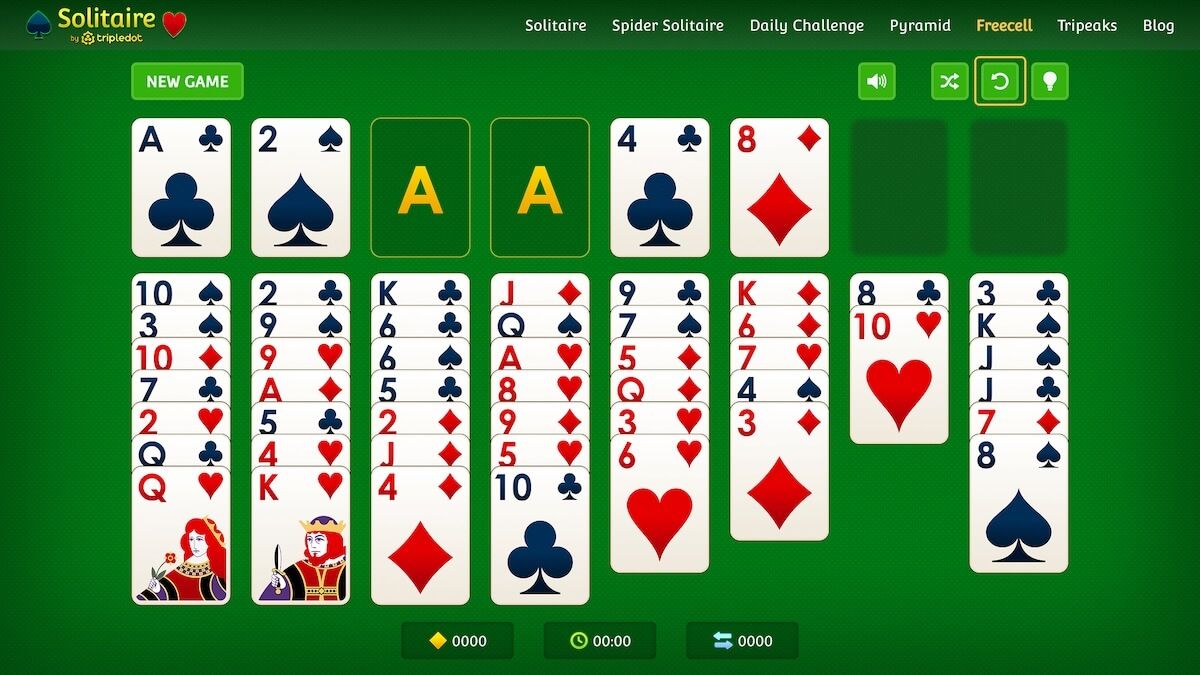
Use Undo freely. There is no penalty for going back. Trying different moves is one of the best ways to learn what works. Even experienced FreeCell players use Undo to test strategies. For more ideas, explore our FreeCell tips and tricks guide.
Don't fill all four free cells at once. Keep at least one open for flexibility.
Try our daily Solitaire challenges for extra practice. Each puzzle is solvable, so it's a great way to build confidence. You can also try Spider Solitaire for a different challenge.
FreeCell vs Solitaire: What's the Difference?
FreeCell and classic Solitaire (also called Klondike) share the same goal but play very differently.
In FreeCell, all 52 cards are face-up from the start. In Klondike, most cards begin face down and are revealed as you play. This makes FreeCell more about strategy and Klondike more about luck.
FreeCell uses eight columns and four free cells for temporary storage. Klondike uses seven columns and a stock pile to draw new cards. FreeCell has no stock pile at all.
Another key difference involves empty columns. In FreeCell, any card can fill an empty column. In Klondike, only Kings can go there. This gives FreeCell players more flexibility.
The win rates also differ significantly. Nearly 99.999% of FreeCell deals can be solved with the right approach. Klondike win rates are much lower.
If you enjoy the surprise of drawing cards face down, play classic Solitaire. If you prefer planning every move with full information, FreeCell is your game.
Is Every FreeCell Game Winnable?
Nearly every FreeCell Solitaire deal is solvable, but not all of them.
Approximately 99.999% of FreeCell deals can be won with the right sequence of moves. Out of the first 1 million numbered deals, only 8 are confirmed unwinnable.
The most famous unsolvable deal is #11982 from the original Microsoft FreeCell. That version had 32,000 numbered games. Deal #11982 was the only one that neither players nor computers could solve.
Most players win around 40-50% of their games because finding the ideal sequence is genuinely difficult. Your win rate improves with practice. If you get stuck, use the Undo button or start a fresh game.
FreeCell Win Rate Statistics and Average Game Time
FreeCell Solitaire has one of the highest solvability rates of any solitaire card game.
Here are some key numbers:
- Theoretical solvability: approximately 99.999% of all deals
- Human win rate: around 40-50%, depending on experience
- Average game length: 5-15 minutes per game
- Minimum possible moves to win: 52 (one per card, rare)
Solitaire.com uses classic scoring for FreeCell. Your score reflects the number of moves and time taken to complete a game. Fewer moves and faster times mean a better score.
Your results improve as you practice. The Hint and Undo features on Solitaire.com help you learn from each game.
Frequently Asked Questions
How do you set up FreeCell?
Deal all 52 cards face-up into eight columns. The first four columns each get 7 cards. The last four get 6 cards each. Four free cells and four Foundation piles sit above the columns, all starting empty.
What are the basic rules of FreeCell?
Build sequences in the tableau by descending rank and alternating colors. Move cards to the Foundation from Ace to King by suit. Use the four free cells as temporary spots for single cards.
Can you win every game of FreeCell?
Nearly every deal is winnable. About 99.999% of FreeCell deals are solvable. Only 8 out of the first 1 million numbered deals are confirmed unwinnable.
What's the best strategy to win FreeCell?
Keep free cells empty as long as possible. Clear columns early for flexibility. Don't rush low cards to the Foundation if they're useful in the tableau. Plan two or three moves in advance.
How is FreeCell different from regular Solitaire?
In FreeCell, all 52 cards are face-up, and there is no stock pile. You get four free cells for temporary storage. Any card can fill an empty column, not only Kings. FreeCell relies more on skill than luck.
Is FreeCell good for your brain?
FreeCell exercises problem-solving, planning, and strategic thinking. Research suggests that card games like FreeCell may support cognitive function and help identify early memory challenges. Learn more about the potential brain benefits of solitaire on Solitaire.com.